David Woodroffe vol1 (RO)

All next drawings are colored using David Woodroffe's "color by numbers" method by Elena Caescu (EC) from Galați România.
© [EC], 2025 — All rights reserved.
All drawings featured on this page are original creations by EC, created according to David Woodroffe's "color by numbers" method. Their display and use on this site is with the EC's explicit consent.
Any reproduction, redistribution, or other use of these drawings outside this website without the author's prior written permission is strictly prohibited.
van Gogh - Autoportret 1889
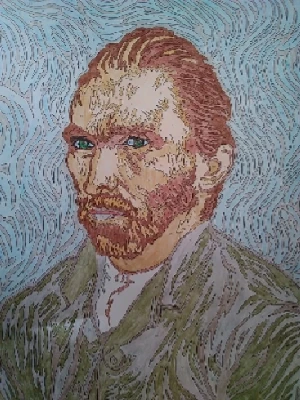
Pictura este expusă în Muzeul Orsay din Paris.
(Sursa: Wikipedia)
(Sursa: Wikipedia)
Vincent Van Gogh painted a number of portraits throughout his artistic career, but this 1889 version, painted only months before his death, is one of the greatest.
The undulating background, contrasted with the fixed, rigid expression on Van Gogh’s face, provides a fascinating contradiction. In this article, Singulart examines the life of Van Gogh, his passion for painting self-portraits, and explore what makes Self Portrait (1889) one of his masterpieces.
(Source: Wikipedia)
The undulating background, contrasted with the fixed, rigid expression on Van Gogh’s face, provides a fascinating contradiction. In this article, Singulart examines the life of Van Gogh, his passion for painting self-portraits, and explore what makes Self Portrait (1889) one of his masterpieces.
(Source: Wikipedia)
Rodin - Ganditorul
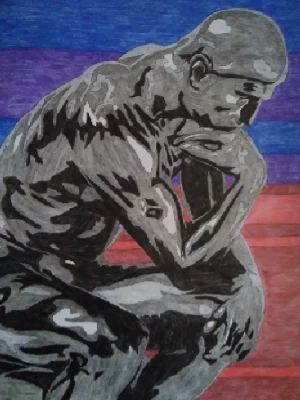
Gânditorul (în franceză Le Penseur) este o sculptură în bronz realizată de Auguste Rodin, amplasată, de obicei, pe un piedestal de piatră. Lucrarea prezintă un bărbat nud așezat pe o stâncă, cu bărbia odihnindu-se pe o mână ca și cum ar fi adâncit în gânduri și este adesea utilizată ca o imagine reprezentativă a filozofiei.
Există aproximativ 28 de piese turnate în mărime completă, cu o înălțime de 186 cm, deși nu toate au fost făcute în cursul vieții lui Rodin și sub supravegherea sa, precum și diverse alte versiuni, unele în ipsos, studii plastice și piese turnate postum, într-o mare gamă de dimensiuni.
Rodin a conceput pentru prima oară această figură în 1880, ca parte a unei alte lucrări, dar prima piesă monumentală din bronz a fost prezentată publicului în 1904.
(Sursa: Wikipedia)
Există aproximativ 28 de piese turnate în mărime completă, cu o înălțime de 186 cm, deși nu toate au fost făcute în cursul vieții lui Rodin și sub supravegherea sa, precum și diverse alte versiuni, unele în ipsos, studii plastice și piese turnate postum, într-o mare gamă de dimensiuni.
Rodin a conceput pentru prima oară această figură în 1880, ca parte a unei alte lucrări, dar prima piesă monumentală din bronz a fost prezentată publicului în 1904.
(Sursa: Wikipedia)
The Thinker (French: Le Penseur), by Auguste Rodin, is a bronze sculpture depicting a nude male figure of heroic size, seated on a large rock, leaning forward, right elbow placed upon the left thigh, back of the right hand supporting the chin in a posture evocative of deep thought and contemplation.
This universally recognized expression of -deep thought- has made the sculpture one of the most widely known artworks in the world. It has become the iconic symbol of thinking; images of the sculpture in profile are often used to indicate philosophy and other practices of contemplation or introspection.
(Source: Wikipedia)
This universally recognized expression of -deep thought- has made the sculpture one of the most widely known artworks in the world. It has become the iconic symbol of thinking; images of the sculpture in profile are often used to indicate philosophy and other practices of contemplation or introspection.
(Source: Wikipedia)
Hokusai - Marele val de la Kanagawa
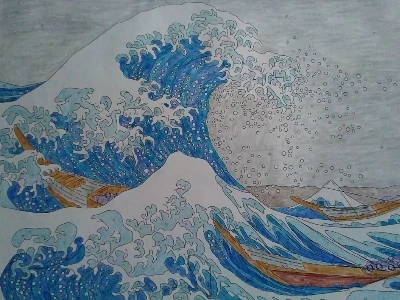
Marele val de la Kanagawa, cunoscut și sub numele de Marele Val sau pur și simplu Valul, este o xilogravură creată prin tehnica blocurilor de lemn de artistul japonez Hokusai. Imaginea a fost publicată între 1829 și 1833, ca prima imagine din seria Treizeci și șase de imagini ale Muntelui Fuji. Este cea mai faimoasă operă creată de Hokusai și una dintre cele mai cunoscute opere de artă japoneză din lume.
Imaginea prezintă un val enorm care pune în pericol bărcile de pe coasta orașului Kanagawa (astăzi orașul Yokohama, Prefectura Kanagawa). Deși uneori s-a presupus că este un tsunami, este mult mai probabil ca valul să fie un val seismic de dimensiune mare. Ca în multe dintre imaginile din serie, este ilustrată zona din jurul Muntelui Fuji într-un moment specific, iar muntele apare în fundal.
Imprimări originale ale tiparului există în multe colecții din Occident, printre care la Muzeul Metropolitan de Artă, British Museum, Institutul de Artă din Chicago, Los Angeles County Museum of Art, Galeria Națională Victoria din Melbourne și în casa lui Claude Monet din Giverny, Franța.
(Sursa: Wikipedia)
Imaginea prezintă un val enorm care pune în pericol bărcile de pe coasta orașului Kanagawa (astăzi orașul Yokohama, Prefectura Kanagawa). Deși uneori s-a presupus că este un tsunami, este mult mai probabil ca valul să fie un val seismic de dimensiune mare. Ca în multe dintre imaginile din serie, este ilustrată zona din jurul Muntelui Fuji într-un moment specific, iar muntele apare în fundal.
Imprimări originale ale tiparului există în multe colecții din Occident, printre care la Muzeul Metropolitan de Artă, British Museum, Institutul de Artă din Chicago, Los Angeles County Museum of Art, Galeria Națională Victoria din Melbourne și în casa lui Claude Monet din Giverny, Franța.
(Sursa: Wikipedia)
The Great Wave off Kanagawa is a woodblock print by the Japanese artist Hokusai (1760–1849), created in late 1831 during the Edo period of Japanese history. The print depicts three boats moving through a storm-tossed sea, with a large, cresting wave forming a spiral in the centre over the boats and Mount Fuji in the background.
The print is Hokusai-s best-known work and the first in his series Thirty-six Views of Mount Fuji, in which the use of Prussian blue revolutionised Japanese prints. The composition of The Great Wave is a synthesis of traditional Japanese prints and use of graphical perspective developed in Europe, and earned him immediate success in Japan and later in Europe, where Hokusai-s art inspired works by the Impressionists. Several museums throughout the world hold copies of The Great Wave, many of which came from 19th-century private collections of Japanese prints. Only about 100 prints, in varying conditions, are thought to have survived into the 21st century.
The Great Wave off Kanagawa has been described as -possibly the most reproduced image in the history of all art-, as well as being a contender for the -most famous artwork in Japanese history-.
This woodblock print has influenced several Western artists and musicians, including Claude Debussy, Vincent van Gogh and Claude Monet.
Hokusai-s younger colleagues Hiroshige and Utagawa Kuniyoshi were inspired to make their own wave-centric works.
(Source: Wikipedia)
The print is Hokusai-s best-known work and the first in his series Thirty-six Views of Mount Fuji, in which the use of Prussian blue revolutionised Japanese prints. The composition of The Great Wave is a synthesis of traditional Japanese prints and use of graphical perspective developed in Europe, and earned him immediate success in Japan and later in Europe, where Hokusai-s art inspired works by the Impressionists. Several museums throughout the world hold copies of The Great Wave, many of which came from 19th-century private collections of Japanese prints. Only about 100 prints, in varying conditions, are thought to have survived into the 21st century.
The Great Wave off Kanagawa has been described as -possibly the most reproduced image in the history of all art-, as well as being a contender for the -most famous artwork in Japanese history-.
This woodblock print has influenced several Western artists and musicians, including Claude Debussy, Vincent van Gogh and Claude Monet.
Hokusai-s younger colleagues Hiroshige and Utagawa Kuniyoshi were inspired to make their own wave-centric works.
(Source: Wikipedia)