David Woodroffe vol2 (RO)

All these drawings are colored using David Woodroffe's "color by numbers" method by Elena Caescu (EC) from Galați România.
© [EC], 2025 — All rights reserved.
for some tests in this vol2... then...
All drawings featured on this page are original creations by EC, created according to David Woodroffe's "color by numbers" method. Their display and use on this site is with the EC's explicit consent.
Any reproduction, redistribution, or other use of these drawings outside this website without the author's prior written permission is strictly prohibited.
Hokusai - Kirifuri waterfall
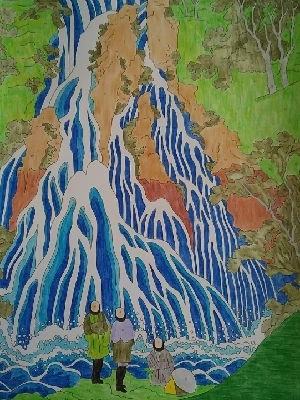
Cascada Kirifuri este o gravură pe lemn realizată de artistul japonez Katsushika Hokusai, parte din seria sa Turul Cascadei în Diverse Provincii (Shokoku taki meguri).
Gravura datează din perioada Edo (1615–1868) și a fost creată în jurul anului 1832. Informații suplimentare:
Artist: Katsushika Hokusai (1760–1849)
Titlu: Cascada Kirifuri la Muntele Kurokami din Shimotsuke (Shimotsuke Kurokamiyama Kirifuri no taki)
Serie: Turul Cascadei în Diverse Provincii (Shokoku taki meguri)
Datare: Aproximativ 1832
Cultură: Japoneză
Tehnică: Gravură pe lemn, cu cerneală și culoare pe hârtie
(Sursa: Rezumat generat de AI)
Gravura datează din perioada Edo (1615–1868) și a fost creată în jurul anului 1832. Informații suplimentare:
Artist: Katsushika Hokusai (1760–1849)
Titlu: Cascada Kirifuri la Muntele Kurokami din Shimotsuke (Shimotsuke Kurokamiyama Kirifuri no taki)
Serie: Turul Cascadei în Diverse Provincii (Shokoku taki meguri)
Datare: Aproximativ 1832
Cultură: Japoneză
Tehnică: Gravură pe lemn, cu cerneală și culoare pe hârtie
(Sursa: Rezumat generat de AI)
A Tour of the Waterfalls of the Provinces (Shokoku taki meguri) is a series of landscape woodblock prints by the Japanese ukiyo-e artist Hokusai.
Completed c. 1833-1834 and containing eight prints, it was the first ukiyo-e series to approach the theme of falling water, and was acclaimed for its innovative and expressive depictions. The waterfalls take up most of each sheet, dwarfing the scenes' human inhabitants, and are rendered by Hokusai with a powerful sense of life, reflecting his animistic beliefs.
(Source: Wikipedia)
Completed c. 1833-1834 and containing eight prints, it was the first ukiyo-e series to approach the theme of falling water, and was acclaimed for its innovative and expressive depictions. The waterfalls take up most of each sheet, dwarfing the scenes' human inhabitants, and are rendered by Hokusai with a powerful sense of life, reflecting his animistic beliefs.
(Source: Wikipedia)
Van Gogh - Sunflowers
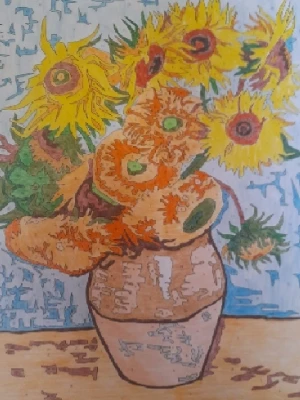
Numele lui Vincent Van Gogh a devenit pentru totdeauna asociat cu cel al florii soarelui; artistul îi scria lui Theo: „floarea soarelui îmi aparține, într-un fel”. Floarea avea o semnificație deosebită pentru el: galbenul simboliza prietenia și speranța, în timp ce floarea în sine exprima gratitudinea.
Acest tablou este probabil cel mai renumit din seria de tablouri reprezentând floarea soarelui creată de Vincent în august și septembrie 1888.
(Sursa: Wikipedia)
Acest tablou este probabil cel mai renumit din seria de tablouri reprezentând floarea soarelui creată de Vincent în august și septembrie 1888.
(Sursa: Wikipedia)
Sunflowers (original title, in French: Tournesols) is the title of two series of still life paintings by the Dutch painter Vincent van Gogh. The first series, executed in Paris in 1887, depicts the flowers lying on the ground, while the second set, made a year later in Arles, shows a bouquet of sunflowers in a vase.
In the artist's mind, both sets were linked by the name of his friend Paul Gauguin, who acquired two of the Paris versions. About eight months later, van Gogh hoped to welcome and impress Gauguin again with Sunflowers, now part of the painted Décoration for the Yellow House that he prepared for the guestroom of his home in Arles, where Gauguin was supposed to stay.
(Source: Wikipedia)
In the artist's mind, both sets were linked by the name of his friend Paul Gauguin, who acquired two of the Paris versions. About eight months later, van Gogh hoped to welcome and impress Gauguin again with Sunflowers, now part of the painted Décoration for the Yellow House that he prepared for the guestroom of his home in Arles, where Gauguin was supposed to stay.
(Source: Wikipedia)
Flaming June
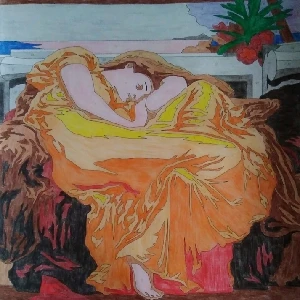
Este o celebră pictură în ulei realizată în 1895 de artistul britanic Sir Frederic Leighton, considerată capodopera sa și un exemplu important al stilului său academic clasicist.
Lucrarea, găzduită la Muzeul de Artă din Ponce, Puerto Rico, înfățișează o femeie adormită, cu pânza transparentă și un fundal de marmură, evidențiind utilizarea luminii naturale și culorile bogate, caracteristice artistului.
Informații cheie despre lucrare:
Artist: Sir Frederic Leighton
Anul realizării: 1895
Tehnica: Ulei pe pânză, pe o pânză pătrată de aproximativ 120x120 cm
Locație: Muzeul de Artă din Ponce, Puerto Rico
Semnificație: Considerată capodopera lui Leighton, ilustrând stilul său clasicist, cu un accent pe realismul materialelor, culori vibrante și lumina naturală.
(Sursa: Rezumat generat de AI)
Lucrarea, găzduită la Muzeul de Artă din Ponce, Puerto Rico, înfățișează o femeie adormită, cu pânza transparentă și un fundal de marmură, evidențiind utilizarea luminii naturale și culorile bogate, caracteristice artistului.
Informații cheie despre lucrare:
Artist: Sir Frederic Leighton
Anul realizării: 1895
Tehnica: Ulei pe pânză, pe o pânză pătrată de aproximativ 120x120 cm
Locație: Muzeul de Artă din Ponce, Puerto Rico
Semnificație: Considerată capodopera lui Leighton, ilustrând stilul său clasicist, cu un accent pe realismul materialelor, culori vibrante și lumina naturală.
(Sursa: Rezumat generat de AI)
Flaming June is a painting by Sir Frederic Leighton, produced in 1895. Painted with oil paints on a 120cm×120cm square canvas, it depicts a sleeping woman in a sensuous version of his classicist Academic style. It is Leighton's most recognisable work, and is much reproduced in posters and other media.
Flaming June disappeared from view in the 1930s and was rediscovered in the 1960s. It was auctioned shortly after, during a period of time known to be difficult for selling Victorian-era paintings, where it failed to sell for its low reserve price of US$140 (the equivalent of $1126 in modern prices). After the auction, it was promptly purchased by the Museo de Arte de Ponce in Ponce, Puerto Rico.
It was brought back to the UK to be displayed at the Royal Academy of Art in 2024 where it was presented as the masterpiece by the artist for his retrospective.
(Source: Wikipedia)
Flaming June disappeared from view in the 1930s and was rediscovered in the 1960s. It was auctioned shortly after, during a period of time known to be difficult for selling Victorian-era paintings, where it failed to sell for its low reserve price of US$140 (the equivalent of $1126 in modern prices). After the auction, it was promptly purchased by the Museo de Arte de Ponce in Ponce, Puerto Rico.
It was brought back to the UK to be displayed at the Royal Academy of Art in 2024 where it was presented as the masterpiece by the artist for his retrospective.
(Source: Wikipedia)