David Woodroffe vol3 (EN) in progress

All these drawings are colored using David Woodroffe's "color by numbers" method by Elena Caescu (EC) from Galați România.
© [EC], 2025 — All rights reserved.
All drawings featured on this page are original creations by EC, created according to David Woodroffe's "color by numbers" method. Their display and use on this site is with the EC's explicit consent.
Any reproduction, redistribution, or other use of these drawings outside this website without the author's prior written permission is strictly prohibited.
Nefertiti
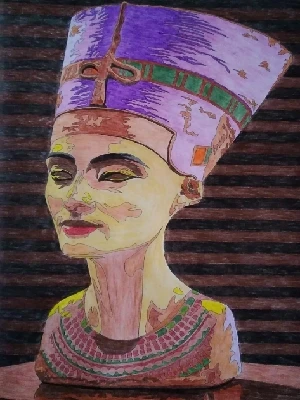
Nefertiti (numele egiptean însemnând „Frumoasa care, iată, vine”; născută in 1370 î.Hr., Teba, Guvernoratul Qena, Egipt – decedata 1330 î.Hr., Amarna, Al Minya, Egipt) a fost o regină a Egiptului antic din Dinastia a XVIII-a, „Marea soție” a faraonului Amenhotep al IV-lea, zis și Akhenaton. Ea a domnit aproximativ între 1379-1361 î.Hr., în vremea marii reforme religioase conduse de acest faraon, care a promovat cultul unic al discului solar, Aten. Ea a fost și soacra și, se pare, și mama vitregă a faraonului Tutankhamon.
Nefertiti a devenit cunoscută în secolul al XX-lea mai ales datorită bustului ei, ajuns în colecția Muzeului egiptean din Berlin, și care face parte în prezent din Muzeul Nou. Bustul lui Nefertiti, în mai multe variante, a fost una din cele mai des copiate sculpturi dintre cele ce ne-au parvenit din Egiptul antic. Titlurile reginei Nefertiti erau numeroase, de exemplu, la Karnak sunt inscripții în care este denumită „Moștenitoarea, cea mare în grații, cea plină de farmec, marea aducătoare de fericire, doamna gingășiei, foarte iubită, care liniștește inima regelui în casa sa, în toate dulce vorbitoare, Stăpâna Egiptului de Sus și de Jos, Marea Soție a regelui, care o iubește, Doamna celor două țări, Nefertiti”.
(Sursa: Wikipedia)
Nefertiti a devenit cunoscută în secolul al XX-lea mai ales datorită bustului ei, ajuns în colecția Muzeului egiptean din Berlin, și care face parte în prezent din Muzeul Nou. Bustul lui Nefertiti, în mai multe variante, a fost una din cele mai des copiate sculpturi dintre cele ce ne-au parvenit din Egiptul antic. Titlurile reginei Nefertiti erau numeroase, de exemplu, la Karnak sunt inscripții în care este denumită „Moștenitoarea, cea mare în grații, cea plină de farmec, marea aducătoare de fericire, doamna gingășiei, foarte iubită, care liniștește inima regelui în casa sa, în toate dulce vorbitoare, Stăpâna Egiptului de Sus și de Jos, Marea Soție a regelui, care o iubește, Doamna celor două țări, Nefertiti”.
(Sursa: Wikipedia)
Nefertiti (1370 – 1330 BC) was a queen of the 18th Dynasty of Ancient Egypt, the great royal wife of Pharaoh Akhenaten. Nefertiti and her husband were known for their radical overhaul of state religious policy, in which they promoted an exclusivist and possible even monotheistic religion, Atenism, centered on the sun disc and its direct connection to the royal household.
With her husband, she reigned at what was arguably the wealthiest period of ancient Egyptian history. After her husband's death, some scholars believe that Nefertiti ruled briefly as the female pharaoh known by the throne name, Neferneferuaten and before the ascension of Tutankhamun, although this identification is a matter of ongoing debate. If Nefertiti did rule as pharaoh, her reign was marked by the fall of Amarna and relocation of the capital back to the traditional city of Thebes.
In the 20th century, Nefertiti was made famous by the discovery and display of her ancient bust, now in Berlin's Neues Museum. The bust is one of the most copied works of the art of ancient Egypt. It is attributed to the Egyptian sculptor Thutmose, and was excavated from his buried studio complex in the early 20th century.
(Source: Wikipedia)
With her husband, she reigned at what was arguably the wealthiest period of ancient Egyptian history. After her husband's death, some scholars believe that Nefertiti ruled briefly as the female pharaoh known by the throne name, Neferneferuaten and before the ascension of Tutankhamun, although this identification is a matter of ongoing debate. If Nefertiti did rule as pharaoh, her reign was marked by the fall of Amarna and relocation of the capital back to the traditional city of Thebes.
In the 20th century, Nefertiti was made famous by the discovery and display of her ancient bust, now in Berlin's Neues Museum. The bust is one of the most copied works of the art of ancient Egypt. It is attributed to the Egyptian sculptor Thutmose, and was excavated from his buried studio complex in the early 20th century.
(Source: Wikipedia)